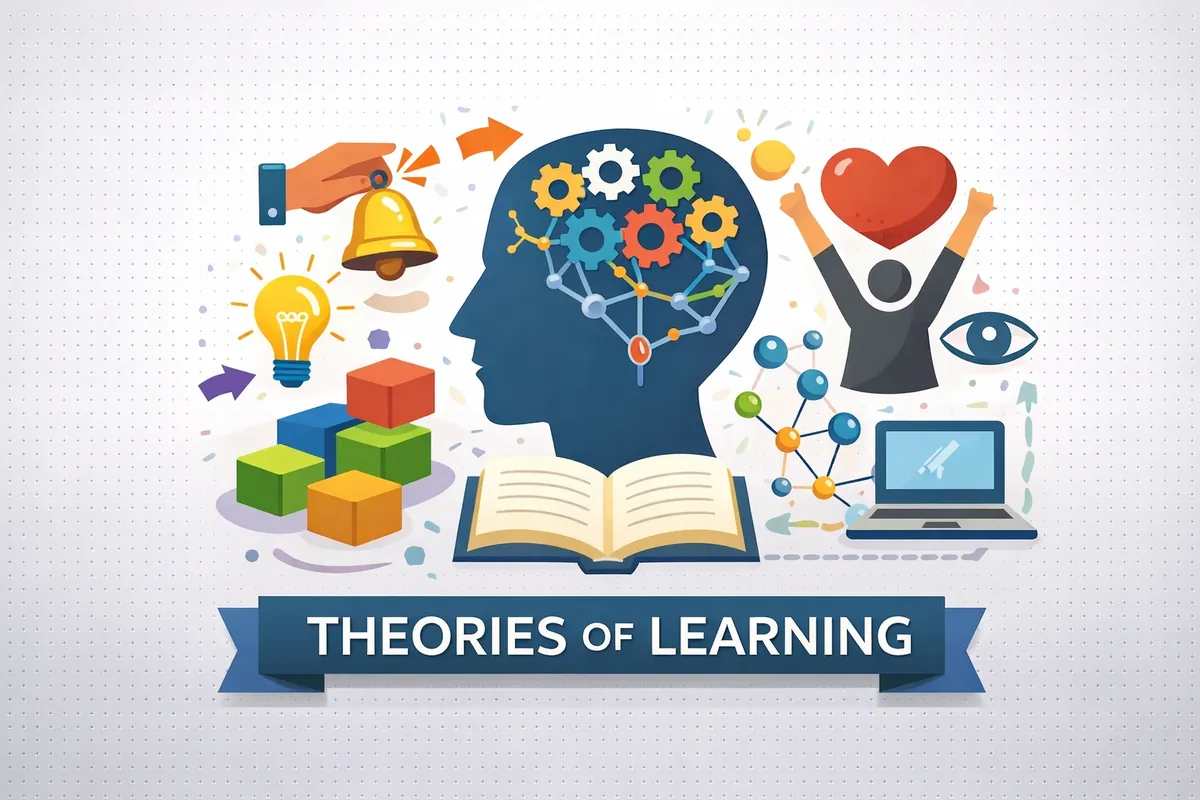
Understanding learning theories is essential for clearing the Child Development & Pedagogy (CDP) section of CTET. These theories explain how children learn, how teachers should teach, and how classrooms should be designed.
In this blog, we’ll cover the most important learning theories, their key ideas, and their proponents—all aligned with CTET exam requirements.
1. Behaviorism Theory (Learning by Conditioning)
Key Proponents:
- Ivan Pavlov
- B.F. Skinner
- Edward Thorndike
Core Idea:
Learning is a change in behavior due to stimulus-response connections.
Important Concepts:
- Classical Conditioning (Pavlov)
- Operant Conditioning (Skinner)
- Law of Effect (Thorndike)
CTET Tip:
- Reinforcement (reward/punishment) is key
- Focus on observable behavior
2. Constructivism Theory (Learning by Doing)
Key Proponents:
- Jean Piaget
- Lev Vygotsky
Core Idea:
Learners actively construct their own knowledge through experiences.
Important Concepts:
- Schema (Piaget)
- Zone of Proximal Development (ZPD) (Vygotsky)
- Scaffolding
CTET Tip:
- Child is an active learner
- Teacher acts as a facilitator
3. Cognitive Theory (Learning as Mental Processing)
Key Proponents:
- Jerome Bruner
- Wolfgang Köhler
Core Idea:
Learning involves thinking, memory, perception, and problem-solving.
Important Concepts:
- Insight Learning (Köhler)
- Discovery Learning (Bruner)
- Information Processing
CTET Tip:
- Focus on understanding, not rote learning
- Emphasis on mental processes
4. Social Learning Theory (Learning by Observation)
Key Proponent:
- Albert Bandura
Core Idea:
Children learn by observing and imitating others.
Important Concepts:
- Modeling
- Imitation
- Vicarious Reinforcement
CTET Tip:
- Teacher acts as a role model
- Behavior is learned socially
5. Humanistic Theory (Learning for Self-Development)
Key Proponents:
- Abraham Maslow
- Carl Rogers
Core Idea:
Learning focuses on personal growth and self-actualization.
Important Concepts:
- Maslow’s Hierarchy of Needs
- Learner-centered education
- Emotional well-being
CTET Tip:
- Safe and supportive environment is essential
- Focus on student motivation and feelings
 Quick Revision Table
| Theory | Proponent(s) | Key Idea |
|---|---|---|
| Behaviorism | Pavlov, Skinner, Thorndike | Learning = behavior change |
| Constructivism | Piaget, Vygotsky | Learning = active construction |
| Cognitive | Bruner, Köhler | Learning = mental processes |
| Social Learning | Bandura | Learning = observation |
| Humanistic | Maslow, Rogers | Learning = personal growth |
Final CTET Strategy
- Focus on application-based questions
- Understand differences between theories
- Learn keywords + proponents together
- Practice MCQs regularly
Conclusion
For CTET success, don’t just memorize theories—understand their classroom application. Most questions are scenario-based, so conceptual clarity is essential.